

-

 Meatdryer Artisan KitMeatdryer Artisan Kit
- Regular price
-
£175.00 GBP - Regular price
-
- Sale price
-
£175.00 GBP
Quick view
-

 Accessory Meat Hanging HookAccessory Meat Hanging Hook
- Regular price
-
£19.00 GBP - Regular price
-
- Sale price
-
£19.00 GBP
Quick view
-

 Protective Fly Net for Drying Meat & GameProtective Fly Net for Drying Meat & Game
- Regular price
-
£30.00 GBP - Regular price
-
- Sale price
-
£30.00 GBP
Quick view


What's happening in there
Two processes run at once, and only one of them is welcome.
The good one is the meat's own enzymes — calpains and cathepsins — quietly taking the muscle fibres apart. That's the tenderness. Alongside it, water leaves through the surface, and everything that made the meat taste like itself stays behind in less of it. That's the depth of flavour people describe as beefy, or nutty, or just more.
The unwelcome one is bacterial spoilage. Cold, airflow and clean handling keep the two apart, which is why everyone who does this pays attention to conditions.
The outside dries into a hard crust as it goes. That crust is trimmed off at the end and doesn't come back as steak, which is why dry aging starts with a big piece and why individual steaks aren't worth aging — there'd be nothing left.
How long it takes depends on the animal and the cut. Roe deer is finished in a few days; a premium beef cut takes weeks, and rewards the wait. Every recipe in the app carries its own target — in aging days or degree days, whichever you'd rather follow.
-
Somewhere cold
A normal fridge holds it comfortably, and that's what most people use. A cellar or an outbuilding does the same in the right season, and a chill room is better equipped than any cabinet you could buy. What matters is that the cold is steady — not where it comes from.
-
Humidity in the right range
The one that catches people out, because it goes wrong both ways. Too damp and the surface never dries. Too dry and it hardens before the inside has done anything. A fridge usually errs dry, a cellar damp — and neither is fixable if you can't see it.
-
Air moving around the meat
Enough that the surface dries rather than sweats. Hanging the meat instead of laying it on a shelf does most of this on its own, because air can reach every side of it. A small fan finishes the job, and a wire shelf beats a solid one.
-
Something to hang it from
Food-safe meat hooks, always. Most cuts hang from a small stainless one like the accessory hook. A whole animal is a different job — rigid hooks, a rail and a hoist.
-
A way to know when it's ready
The only one of the five we make, and the only one that was ever difficult.
Where you hang it
A spare fridge is the usual answer and the easiest one. Nothing to modify — the hook hangs from a shelf rail or a bar, and everything else happens in the app.
The fridge you use every day is the one people will tell you not to use, and their reason is a good one: the thermostat is approximate, the door opens all day, and you have no idea what either of those did to the meat. That was true. It's the part that changed — you can see the swings now, and see whether they mattered.
A cellar or an unheated garage is how this was done long before fridges, and in the right season it still is. It holds humidity better than a fridge does and holds temperature worse, so it drifts the other way. Anywhere that isn't sealed, hang the protective net as well — keep it clear of the meat and clear of the lower part of the hook, or it will lean on the weight reading.
A chill room or a cold larder is where whole animals hang, and it is already better equipped than any domestic fridge.
A wine fridge holds cold well and moves very little air. Hanging helps. Crowding it doesn't.
Set up any of these and you have what people mean by a dry aging chamber. It isn't a machine — it's a cold space with something hanging in it, and something measuring.
Do you need a dry aging fridge?
A dry aging cabinet is a fine thing to own, and plenty of people want one — but you don't need one to start, and you don't need one to get a good result. A fridge you already own gives you the cold and most of the airflow. What a cabinet adds is control of the humidity. What none of them add is a way to know when the meat is ready.
A cabinet buys convenience. Building one buys control — a humidity controller and a humidifier will hold the range better than a fridge does on its own. Converting a fridge you already have buys neither, and mostly it doesn't need to: what it needs is for you to be able to see where it landed.
A dry aging cabinet
A chamber you build
A fridge you own
The most, by a distance — you're buying a compressor twice
Parts, and they add up
What you've already spent
Plug it in
A controller, a humidifier, a fan, and a few weekends
Nothing to drill or modify
Floor space, to a machine that does one job
The weekends, and there's nobody to call when it misbehaves
Tighter humidity control, and the fridge is doing another job meanwhile
No
No
No
How you know it's ready
This is the part that used to come down to opening the door and forming an opinion.
Dry aging has always run on three things: temperature, humidity and time. The Meatdryer reads all three continuously and follows them against the recipe you picked — that's what aging days and degree days are built on, and it works whatever you're hanging and however heavy it is. Keep the Meatdryer near the meat and it reads the conditions the meat is in.
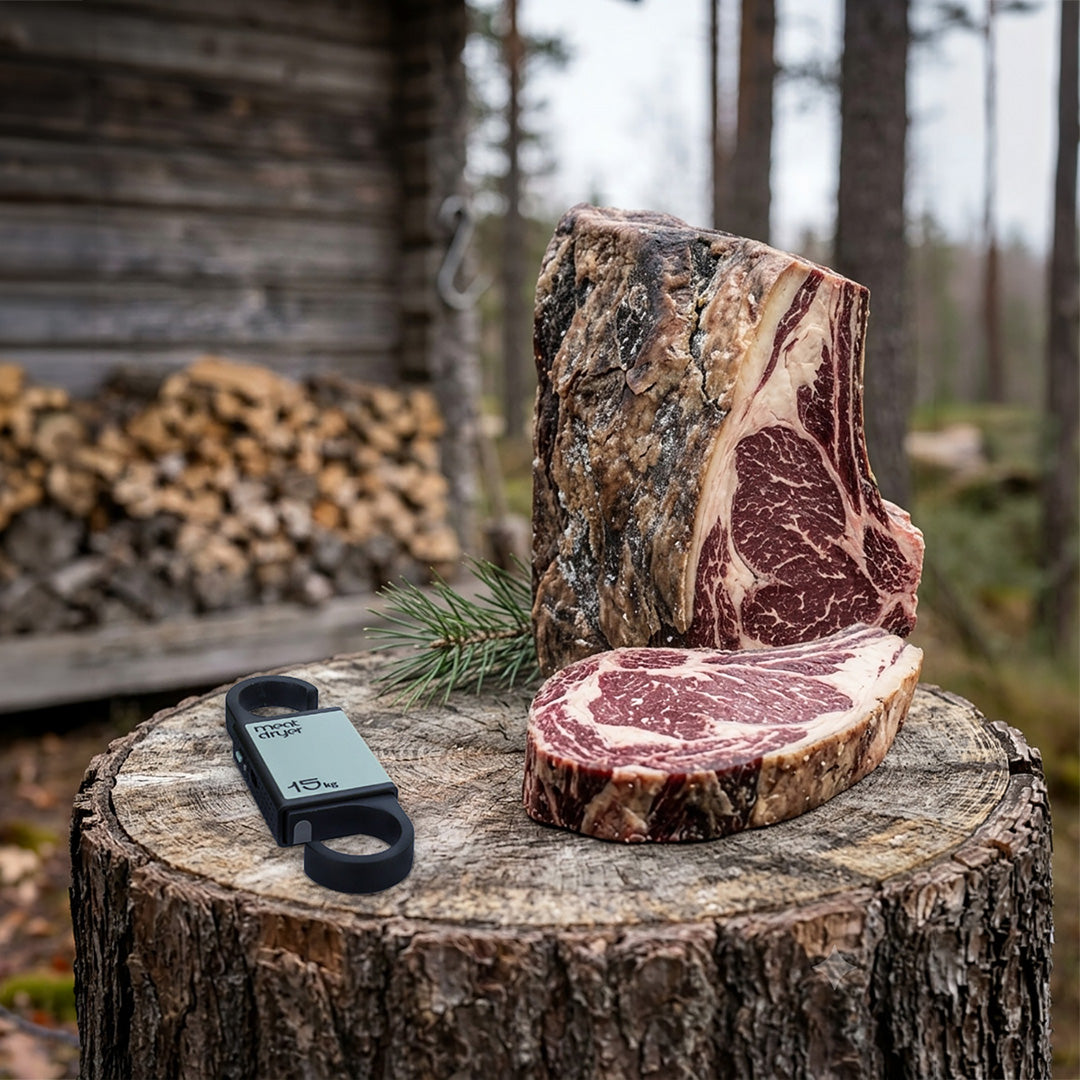
Up to 15 kg (33 lb) you can hang the meat from the Meatdryer and add a fourth dimension: weight. Water loss is the one measure you cannot judge by looking, smelling or pressing, and on a cut it's what turns a good estimate into a finished answer.
It also flags drift. Rather than leaving you to read a number, it shows how far the temperature and humidity have moved from what the recipe asks for — which is how you find out that a full fridge dried out, or that the cellar got damp, while there's still time to do something about it.
And you don't have to be standing next to it. Over WiFi the Meatdryer measures and reports on its own, so a cut hanging in the cellar is something you check on your phone — and where there's no WiFi, it keeps measuring and syncs to your phone when you're next nearby.
Either way it works as a tenderising timer, following the recipe's target and showing you the conditions it got there under. That's how a good result becomes one you can repeat rather than one you got lucky with.
-
Dry aging
Cold, air and time acting on a whole cut or a whole animal. Nothing is added. This is the one this page is about.
-
Curing - Salting, then drying
Starts with salt, and usually a cure, before anything gets hung. Salami, pancetta, coppa, a whole ham. It's measured exactly the same way — hung in cold moving air, tracked to a target — which is why the same hook does both, and why a sausage dryer is doing the same job as a whole muscle hung to dry.
-
A biltong box
Works warm and fast on thin strips, with a fan pushing air across them. Different process, different result.
-
A dehydrator
Applies heat to thin slices until they're jerky. Good appliance for that, poor one for everything above, because heat is precisely what dry aging doesn't want.
-
Beef
Where the difference is most obvious, and what most dry aging equipment gets sold for. Every dry aged beef fridge on the market exists for this. A whole cut rather than steaks — a well-marbled rib section or a loin, given a few weeks, comes off the grill with a crust and a concentration of flavour a fresh steak simply doesn't reach. The better the marbling going in, the more there is to gain.
-
Wild game
The older version of the same craft. If you hang your own you're already doing it, usually by counting days. The Meatdryer doesn't change the method; it takes over the counting. A cut, or a whole animal on the rail — venison, boar, moose, lamb, each with its own target in the app, because they genuinely differ.
-
Cured meats
Salami, pancetta, coppa, a whole ham — these start with salt before anything is hung, which makes them curing rather than dry aging. Everything after the salt is the same: hung in cold moving air, tracked to a target, finished when the numbers say so. One hook covers both, and it's where most people go next.
FAQs
Which one do I need?
The Meatdryer Hook is the one to start with — it does the whole job on its own. The Artisan Kit is the premium version: the same measurements, in the brown hook, with an accessory hook to hang the meat from and a tool roll to keep it all in.
Is there a weight limit?
Not for using it. The Meatdryer tracks temperature, humidity and time whatever you're hanging, so for a side or a whole animal you hang the meat from a rail on rigid hooks and keep the Meatdryer nearby. Up to 15 kg (33 lb) the meat can hang from the Meatdryer itself, and weight loss gets tracked as well.
Do I need a humidifier?
In a purpose-built chamber, usually yes — that's most of what the build is. In a fridge or a cellar, start without one. The point isn't to control the humidity from day one, it's to know what it's doing, because a fridge tends to run dry and a cellar tends to run damp, and until you can see which way yours goes you're fixing a problem you haven't measured.
What if I don't have a spare fridge?
A cellar, an unheated garage, a chill room or a wine fridge will all do the job. What matters is cold, air, and being left undisturbed — and the hook shows you whether the space you've chosen is actually delivering it.
Do I have to modify the fridge?
No. Nothing to drill, nothing to wire, nothing that affects a warranty.
Do I need the protective net?
Only if you're hanging somewhere that isn't a sealed fridge — a shed, a garage, a cellar, outdoors.
Does it work for wild game?
It's what many of our customers use it for, whether that's a cut or a whole animal on the rail with the Meatdryer nearby. The app carries targets by animal and cut.
Aging days, temperature and humidity, read where the meat actually hangs.